Bible Prophecy, Signs of the Times and Gog and Magog Updates with Articles in the News
Growing Prophetic Expectation And Confusion Surrounds Middle East Conflict
War in the Middle East has always stirred more than geopolitical analysis. It awakens prophetic expectations and hope.
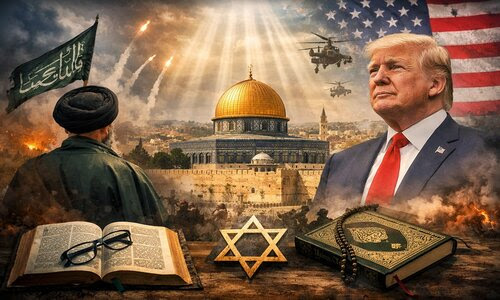
As the conflict between Iran and the United States alongside Israel intensifies, something striking is happening across the world’s major faith communities. Islamic clerics are invoking the return of the Mahdi. Jewish rabbis are speaking openly about redemption and the coming of the Messiah. Some Christians are declaring that America or Donald Trump must play a specific role in the end times.
Prophetic expectation is rising everywhere — but so is confusion.
For Christians who take the Bible seriously, moments like this demand both discernment and humility. Scripture does give us a prophetic framework for the future. But it also warns repeatedly about deception, speculation, and misplaced hope.
To understand the moment, it is worth examining what each major faith tradition is currently saying — and how those interpretations compare with a careful reading of biblical prophecy.
Islamic Expectations: The Mahdi And Apocalyptic War
Within parts of Shiite Islam, especially in Iran, eschatology has always played a significant role in shaping worldview and politics.
Shiite theology anticipates the arrival of the Mahdi, a messianic figure who will appear during a time of global chaos, defeat Islam’s enemies, and establish justice across the world. Some interpretations within the tradition view massive regional war and instability as precursors to his appearance.
In recent days, some Islamic voices have framed the escalating confrontation with Israel and the United States in apocalyptic terms — portraying the conflict as part of a larger cosmic struggle between Islam and the West.
Even more striking, certain online commentators and clerics have begun labeling Donald Trump as a potential “antichrist-like” figure opposing the Islamic end-time deliverer.
Such interpretations highlight how deeply apocalyptic expectation runs across cultures. Yet they also underscore profound theological differences.
The Mahdi of Islamic expectation does not correspond to the biblical Messiah. In fact, many Christian prophecy scholars have long noted that elements of the Mahdi narrative more closely resemble characteristics the Bible attributes to the Antichrist — a charismatic global leader who rises during a time of turmoil and gathers widespread allegiance.
For many Islamic radicals turmoil is not merely endured — it can be welcomed as a necessary step toward redemption. That mindset creates a dangerous dynamic in which war, instability, and confrontation with Israel or the West are sometimes framed as spiritually meaningful and even necessary events rather than tragedies to be avoided.
Jewish Expectations: Redemption And The Coming Messiah
Within parts of the Jewish world, the current conflict is also being viewed through a prophetic lens.
One example drawing attention recently is Rabbi Mendel Kessin, a prominent Torah scholar who recently argued in a widely circulated lecture that the unfolding confrontation with Iran fits within a long-anticipated pattern of Jewish redemption.
According to Kessin’s interpretation, the geopolitical shifts unfolding today mirror ancient biblical themes — including the fall of enemies like Haman in the Book of Esther, the role of global powers aiding Israel, and the eventual rebuilding of the Third Temple in Jerusalem.
Some Jewish voices believe these events could accelerate the arrival of the long-awaited Messiah and usher in a new era for Israel.
Christians who love the Jewish people recognize something important in this perspective: the conviction that God is still actively guiding history and that Israel remains central in His redemptive plan.
Yet Christian prophecy also introduces a crucial warning.
According to the New Testament, the final phase of world history begins with the confirming of a covenant of peace, described in Daniel’s prophecy of the seventy weeks. That agreement launches the final seven-year period often referred to as the Tribulation.
At first, that peace appears genuine.
But Scripture warns that it is temporary — and deceptive.
The same leader who brokers peace ultimately reveals himself as the Antichrist.
This creates a sobering possibility within Christian prophecy teaching: that Israel, seeking peace and security, could one day embrace a global leader who initially appears to fulfill messianic expectations.
Christians therefore view the prophetic future not only with anticipation but also with concern for their Jewish friends — praying that when the true Messiah returns, they will recognize Him as Jesus.
Christian Confusion: When Speculation Replaces Scripture
Ironically, confusion is not limited to other faith traditions.
Within segments of the Christian world, speculation about the current war has also surged.
Some commentators have claimed the conflict proves that America must be the prophetic “Babylon” described inRevelation. Others portray Donald Trump as a kind of divinely appointed messianic figure leading a spiritual battle against evil.
There have even been reports of military leadership describing the confrontation in quasi-religious terms — framing it as a civilizational struggle between Christianity and radical Islam.
But here is where careful biblical interpretation becomes essential.
The Bible is actually silent about the specific role of the United States in end-times prophecy.
Many theories exist. Some speculate America could be Babylon. Others believe it may decline or merge into larger geopolitical alliances.
But Scripture never explicitly names it.
That means Christians must exercise restraint. It is one thing to analyze world events. It is another to declare, “Thus says the Lord,” when the Bible itself does not speak clearly.
Likewise, elevating any political leader to near-messianic status — whether Trump or anyone else — is a serious theological mistake.
God certainly uses world leaders for His purposes. Scripture shows this repeatedly with figures like Cyrus of Persia.
But our hope is never in political power.
Our hope is in Christ alone.
The True Christian Prophetic Posture
So how should Christians respond to a world suddenly obsessed with prophecy?
With seriousness — but also humility.
The Bible does describe a future period of global turmoil, deception, and ultimately redemption. It tells us that Israel will remain central to God’s unfolding plan. And it warns repeatedly that the world will be vulnerable to false messiahs promising peace and security.
Yet it also reminds believers of something even more important.
Prophecy was never meant to produce panic or worry.
It was meant to produce watchfulness.
The current war may or may not connect directly to future prophetic events. History is filled with conflicts that seemed apocalyptic in the moment but ultimately were not the final chapter. The war with Iraq is a more recent example in history. They were only part of the larger unfolding puzzle.
What matters most is that believers understand the Scriptures well enough to recognize the real thing when it comes.
Because across Islam, Judaism, and Christianity, prophetic expectation is rising.
But only one prophetic timeline ultimately matters — the one written in the Word of God.
And in that timeline, the final hope of the world is not a Mahdi, not a political leader, and not even a human peacemaker.
It is the road that leads to the return of Jesus Christ.
END OF ARTICLE
PASTOR DIRK SAYS ::
We are Living in the End Times , we can Clearly see that in Every News Article and Events Around the word . But there is 18 HIGH News Events that have to take place before the Second Coming of Jesus , the Rapture there AFTER at the Battle of Armageddon.
18 Major News Announcements before the Return of Jesus and the Rapture.
The Next Major News Event =
1. a Nuclear War in the Middle East – The Gog and Magog war – Ezek 38 – 39 .
Eze 39:8-10 Behold, it is come, and it is done, saith the Lord GOD; this is the day whereof I have spoken.
And they that dwell in the cities of Israel shall go forth, and shall set on fire and burn the weapons, both the shields and the bucklers, the bows and the arrows, and the handstaves, and the spears, and they shall burn them with fire seven years:
So that they shall take no wood out of the field, neither cut down any out of the forests; for they shall burn the weapons with fire: and they shall spoil those that spoiled them, and rob those that robbed them, saith the Lord GOD.
After This. 2. The Jewish Messiah Arrives . Note this was and will not be Jesus
After This. 3. Israel Receives their approval to Build the 3rd Jewish Temple – Rev 11
Rev 11:1-3 And there was given me a reed like unto a rod: and the angel stood, saying, Rise, and measure the temple of God, and the altar, and them that worship therein.
But the court which is without the temple leave out, and measure it not; for it is given unto the Gentiles (Muslims): and the holy city shall they tread under foot forty and two months.
And I will give power unto my two witnesses, and they shall prophesy a thousand two hundred and threescore days, clothed in sackcloth.
After This. 4. The Country of Palestine is Born , Matt 24
Mat 24:15-16 When ye therefore shall see the abomination of desolation, spoken of by Daniel the prophet, stand in the holy place, (whoso readeth, let him understand:)
Then let them which be in Judaea flee into the mountains:
After This. 5. The Great Christian Revival, Acts 2 v 17-21
Act 2:16-21 But this is that which was spoken by the prophet Joel;
And it shall come to pass in the last days, saith God, I will pour out of my Spirit upon all flesh: and your sons and your daughters shall prophesy, and your young men shall see visions, and your old men shall dream dreams:
And on my servants and on my handmaidens I will pour out in those days of my Spirit; and they shall prophesy:
And I will shew wonders in heaven above, and signs in the earth beneath; blood, and fire, and vapour of smoke:
The sun shall be turned into darkness, and the moon into blood, before that great and notable day of the Lord come:
And it shall come to pass, that whosoever shall call on the name of the Lord shall be saved.
After This. 6. The Antichrist claims the 3rd Jewish Temple. Daniel 12 . Matt 24.
After This, 7. The Great Tribulation Starts. Rev 12 , Matt 24
After This. 8. The 666 Mark of the Beast is Implemented . Rev 13
After This. 9. The Seal of God Rev 7 and 9
After This. 10. Jews and Christians go into Angel Protection. Rev 12 and Ps 91
After This. 11. The 5th Trumpet = Super Volcano Erupts announcing the Wrath of God. Rev 9
After This. 12. All Bearers of the 666 receive painful and incurable sours on their bodies. Rev 16
After this. 13. The Sea water changes to stale dead Blood, all sea foods dies.Rev 16
After this, 14. All fresh water turn to stale Blood. All animals and plants dies, Rev 16
After This. 15, 6th Trumpet War about left over canned foods and bottle water products and Oil . Rev 9
After This . 16 . The Sun Explodes , Burns Humans and Fires on Earth , High Heat . Rev 16
After This . 17 . Sun Burns Out , Total Darkness on Earth. Moon no Light , Stars look like they fell out of the Sky. Rev 16
After This . 18. Blood in Euphrates river dries up. for troops of World Army to battle God. Rev 16
After This . Jesus Christ Arrive at His 2nd Coming
Mat 24:29-31 Immediately after the tribulation of those days shall the sun be darkened, and the moon shall not give her light, and the stars shall fall from heaven, and the powers of the heavens shall be shaken: And then shall appear the sign of the Son of man in heaven: and then shall all the tribes of the earth mourn, and they shall see the Son of man coming in the clouds of heaven with power and great glory. And he shall send his angels with a great sound of a trumpet, and they shall gather together his elect from the four winds, from one end of heaven to the other.
After This . The Rapture of the Elect .
1Th 4:14-17 For if we believe that Jesus died and rose again, even so them also which sleep in Jesus will God bring with him.
For this we say unto you by the word of the Lord, that we which are alive and remain unto the coming of the Lord shall not prevent them which are asleep.
For the Lord himself shall descend from heaven with a shout, with the voice of the archangel, and with the trump of God: and the dead in Christ shall rise first:
Then we which are alive and remain shall be caught up together with them in the clouds, to meet the Lord in the air: and so shall we ever be with the Lord.
After This . The Battle of Armageddon . Rev 16 to 20
And This will Happen in the Last 10 Years on Earth!
The Oil War Has Begun: U.S. And Iran Target Energy Lifelines

War has many fronts—land, air, sea, and cyberspace. But in the past 72 hours, the conflict between the United States and Iran appears to have opened a new and potentially more dangerous front: oil itself.
What began primarily as strikes on military bases, missile facilities, and command centers has shifted dramatically toward energy infrastructure. Oil depots, refineries, tanker routes, and export hubs are now being targeted across the Middle East. The message from both sides is clear: if you cannot defeat your enemy quickly on the battlefield, you can still damage them—and the world—through the price of energy.
The result is a rapidly escalating “oil for oil” war, where each side seeks to disrupt the other’s energy lifeline.
The Fires Over Tehran
One of the most striking images of the war so far came this week when massive flames lit the night sky over Tehran after strikes hit major fuel storage facilities. Witnesses described enormous columns of fire and smoke rising from the city’s oil depots after multiple storage tanks and fuel transfer facilities were hit.
These depots were reportedly tied to Iran’s military fuel supply network, but the symbolism was unmistakable: Iran’s energy backbone had been placed directly in the crosshairs.
It marked a turning point in the war.
Iran Strikes Back at the Oil Network
Iran did not take long to retaliate—and it did so in a way designed to send shockwaves through global markets.
Rather than focusing solely on U.S. forces, Iranian attacks have increasingly targeted the broader energy network of American allies across the region.
In the past week alone, at least five major oil-related incidents have highlighted this new strategy:
Drone attack on the Ras Tanura refinery in Saudi Arabia, one of the kingdom’s largest oil processing hubs. Even limited damage forced temporary shutdowns and rerouting of exports.
Missile and drone strikes across Saudi Arabia’s Eastern Province, including energy infrastructure linked to oil exports.
Attacks on ports and tankers near Oman, including oil tanker strikes that killed or injured crew members and disrupted shipping routes.
Drone and missile launches toward Gulf energy facilities, including infrastructure tied to exports in the UAE and neighboring states, forcing shutdowns and raising regional security alerts.
Missile strike on Bahrain’s BAPCO oil refinery, which triggered fires and emergency response operations at one of the island nation’s key petroleum facilities.
The result is not simply battlefield damage. It is a deliberate attempt to weaponize global energy markets.
Oil Prices Are Already Surging
The strategy is working.
Oil prices have already jumped dramatically since the conflict intensified. Global benchmarks have surged as markets price in the possibility of prolonged supply disruptions across the Persian Gulf.
Analysts now warn that if disruptions worsen—especially if shipping slows through the Strait of Hormuz—oil could spike dramatically as a large share of global supply moves through that narrow passage.
That chokepoint is critical: nearly 20% of the world’s oil supply moves through the Strait each day.
Even partial disruptions have already rattled global markets and triggered warnings about sustained energy volatility.
In other words, the war’s newest battlefield may be thousands of miles from Tehran or Washington—but it is already hitting the global economy.
The First Economic Shockwaves
The first industry to sound the alarm has been aviation.
Airlines depend heavily on jet fuel, which can account for roughly 20% of operating costs. As oil prices spike, airline executives have already warned that ticket prices will rise if the conflict continues.
For travelers, that could mean higher airfare within weeks.
But aviation is only the beginning.
Higher oil prices ripple across nearly every sector of modern life:
- Shipping costs increase
- Food prices rise due to transportation costs
- Manufacturing becomes more expensive
- Inflation accelerates
Even temporary disruptions in Middle Eastern energy infrastructure have historically triggered global inflation shocks—and this conflict is already moving in that direction.
A Dangerous New Phase of the War
What makes this moment especially dangerous is that neither side needs to destroy massive oil fields to cause economic chaos.
Simply creating uncertainty is enough.
If tankers avoid the Persian Gulf…
If refineries shut down out of security concerns…
If insurers refuse to cover ships in the region…
Global supply can tighten almost overnight.
This is why energy markets react so violently to even limited strikes.
And it explains why the war may now evolve into a contest of economic pressure rather than purely military victory.
The Real Battlefield: Global Markets
In a sense, the new strategy is brutally simple.
The United States and its allies can strike Iranian energy infrastructure to choke off revenue for Tehran.
Iran, in response, can threaten the oil lifeline of the entire Middle East.
Both sides understand the same truth: whoever disrupts oil the most can shake the world economy.
And when oil becomes the weapon, everyone becomes a participant in the war—whether they realize it or not.
From airline tickets to gasoline pumps to grocery store prices, the conflict in the Middle East may soon be felt in everyday life around the globe.
The fires burning over oil depots tonight are not just battlefield explosions.
They may be the first sparks of the next global economic shock.
Trump: Ending Iran war will be ‘mutual’ US-Israeli decision

The White House now estimates the war against Iran could last four to six weeks.
President Donald Trump said the United States and Israel are fully aligned on a timeline for concluding the war against Iran, stressing that the decision to end the conflict would consider the opinion of Israeli Prime Minister Benjamin Netanyahu.
Speaking to The Times of Israel on Sunday, Trump said he had been discussing the timeframe for ending the military campaign with Netanyahu.
He added that the decision on when to stop fighting would be “mutual,” while noting that Washington would ultimately have the final say.
“I’ll make a decision at the right time, but everything’s going to be taken into account,” Trump told ToI.
Trump emphasized that the war against Iran was necessary in order to protect the existence of the Jewish state and ensure stability in the region.
“Iran was going to destroy Israel and everything else around it… We’ve worked together. We’ve destroyed a country that wanted to destroy Israel,” Trump said.
Trump was also asked whether Israel would be permitted to continue striking Iran after the United States ends its military operations against the Islamic Republic.
If US & Iran reach deal Israel will attack Iran’s ballistic missile sites alone
“I don’t think it’s going to be necessary,” Trump replied.
The president initially suggested that the campaign against Iran would last only a few days. Since then, however, he has expanded that timeframe.
More recently, Trump has avoided giving an estimate for how long the war will continue.
Last Friday, White House spokeswoman Karoline Leavitt said the current expectation is that the war could last between four and six weeks.
Trump also predicted that Iran’s defeat would have broader consequences across the region, particularly for Iran-backed terror groups.
He said the outcome of the war could pressure organizations such as Hamas to disarm.
“Many people will disarm because of [the war against Iran],” he said. “Because right now, Iran is in a position that it’s never known before, and it’s only going to get worse for them.”