Bible Prophecy, Signs of the Times and Gog and Magog Updates with Articles in the News
Why Do They March For Gaza, But Not Iran?
On November 24, 2025, U.S. President Donald J. Trump signed an executive order initiating a formal process to designate certain chapters of the Muslim Brotherhood as Foreign Terrorist Organizations and Specially Designated Global Terrorists.
The order directs the Secretaries of State and Treasury to assess Muslim Brotherhood chapters in countries such as Egypt, Jordan, and Lebanon and take action under U.S. counterterrorism laws to deprive them of capabilities and resources — a move the executive order explicitly tied to national security priorities after the Hamas invasion of Israel on October 7, 2023 and its aftermath throughout the West. The order also sets a rapid timetable for recommendations on specific chapters.
Trump’s executive order represents the most serious American effort in decades to confront Islamist political networks that, in Washington, had long been considered merely political differences rather than lethal security threats.
Across the Atlantic, however, the response to the same ideological current could not have been more different. In the European Union and many of its major capitals, political Islam — often embodied by Muslim Brotherhood-linked organizations — remains part of an approach for a larger “dialogue with Islamists”. Can you imagine a “dialogue with Bolsheviks” or a “dialogue with the Third Reich”?
Muslim extremists are being treated as a legitimate voice within civil society and political discourse. European policymakers have generally rejected hard designations, instead engaging extremist Muslim networks as stakeholders in “multicultural” governance. This contrast between Washington’s confrontational stance and Brussels’s engagement reflects a deep strategic divergence in how the West perceives political Islam.
The United States under the Trump administration frames the Muslim Brotherhood not as a partner in political reform but as a threat to national security. The November 2025 executive order emphasizes the Muslim Brotherhood’s ties to terrorist activities, including support for Hamas and other terrorist organizations. Trump’s directive instructs the administration to compile evidence for designations that could criminalize material support and curtail international operations of Muslim Brotherhood branches.
The president’s moves follow years of debate within the U.S. government and Congress over whether or not the Muslim Brotherhood qualifies as a terrorist organization. Historically, U.S. administrations differentiated between violent jihadist groups — such as al-Qaeda and ISIS — and Islamist political movements such as the Muslim Brotherhood, which often participated in elections or civil society. But the combination of global Islamist violence and the Muslim Brotherhood’s network of affiliates has shifted the American calculus toward confrontation. In parallel, new efforts in the 119th Congress have again pushed for statutory designation frameworks.
By contrast, the European Union has taken a far more cautious, at times permissive, approach, apparently preferring to regard Islamic extremists as potential voters. Brussels and member-state capitals have engaged with Muslim Brotherhood-linked networks through funding, inclusion in civil society consultations, and incorporation into multicultural policy initiatives. The Forum of European Muslim Youth and Student Organisations, for instance, represents a pan-European network active in EU political spaces and has been accused in some reports of links to the Muslim Brotherhood, although it denies organizational ties.
The structural presence of Muslim Brotherhood-affiliated networks in Europe extends beyond student organizations. The Federation of Islamic Organizations in Europe, founded in 1989 and headquartered in Brussels, serves as an umbrella for dozens of Islamic groups and has acted as a recognized interlocutor with European institutions. While it portrays itself as representing mainstream Muslim interests, academic and policy research has highlighted its foundational ties to the Muslim Brotherhood and transnational Islamist ideology.
This European policy of “dialogue” stems from a broad belief that incorporating “diverse” voices into social and political frameworks diminishes radicalization. Critics, however, argue that engaging groups with ideological linkages to transnational Islamism normalizes political currents that reject liberal European values, and relativizes extremism. In effect, this approach has permitted Islamist organizations to embed themselves in cultural and institutional networks, from youth forums to consultation processes for public policy.
In Belgium and especially Brussels — the seat of the EU — this dynamic is especially visible. Research presented in the European Parliament documents substantial funding streams from EU programs to organizations linked to Muslim Brotherhood networks, prompting alarm among some lawmakers about the integrity of taxpayer funds. These groups have not only received public money but have also been invited into policy dialogues and civil society advisory roles, a situation that would be unthinkable under Trump’s counter-Islamist doctrine.
France offers a microcosm of the broader European dilemma. A government-commissioned report in 2025 alleged that the Muslim Brotherhood’s networks have quietly expanded influence through schools, mosques, and local NGOs while masking ideological aims under the guise of integration and social services. The report prompted French President Emmanuel Macron to convene senior ministers to discuss strategies for responding to what it described as a long-term challenge to France’s secular republican values.
Yet even this steely assessment in France was met with pushback from civil liberties advocates and some academics, who questioned the evidence and warned against “stigmatizing” Muslim communities. Other critics of the report argued that labeling civil society engagement as Islamist penetration risked alienating moderate voices and inflaming social tensions.
This conflict between security concerns and inclusive governance captures the broader European struggle with political Islam.
Germany, too, reflects the complexity of Europe’s approach. The Islamic Community of Germany (IGD), associated with the Federation of Islamic Organizations in Europe, has been recognized by domestic security services as a central organization for Muslim Brotherhood adherents in the country. Nevertheless, it operates openly within Germany’s pluralist framework, illustrating how European institutions can tolerate intolerant Islamist networks within civil society while still claiming to uphold values of freedom and association.
In Sweden, reactions to the French report on the influence of the Muslim Brotherhood illustrate how domestic politics intersect with Europe’s broader policy on Islamism. Sweden’s Employment and Integration Minister Mats Persson responded by convening a “group of experts” to assess extremist Muslim influence, but also faced fierce criticism from Social Democratic leaders who dismissed the allegations against the Muslim Brotherhood as politically motivated, reflecting a deep divide over how to treat political Islam.
Across Europe, extremist Muslim organizations have also established strong youth and educational networks. Reports identify associations — some linked to the Muslim Brotherhood — that operate schools, youth programs, and cultural centers. In France alone, hundreds of such associations, including mosques and educational institutions, have been identified as connected with Muslim Brotherhood ideology, revealing the depth of the movement’s entrenchment within civic structures.
The Muslim Brotherhood presence within civic structures is not incidental. Analysts note that its affiliate groups often employ “entryism,” which is defined as:
“The tactic pursued by extremist parties of gaining power through covertly entering more moderate, electorally successful, parties. Within those parties they maintain a distinct organization while publicly denying the existence of a ‘party within the party.’”
Basically, entryism enables Islamists to gain influence within official institutions, shape public discourse, and normalize extremist Muslim thinking over decades. The West ends up assimilating into Islam, rather than the other way around.
Rather than confronting liberal democratic values, these “entryist” actors advocate for “reinterpretations” that often blur the lines between religious freedom and political Islam. Critics argue that Europe’s engagement with Muslim Brotherhood networks has consequences beyond domestic politics. When civil institutions mingle with movements supportive of groups such as Hamas — itself the Palestinian branch of the Muslim Brotherhood — it undermines the West’s unified stance against extremist ideologies.
This division is particularly acute in debates over Israel, where EU indecision and ambiguous positions on political Islam — accompanied by well-funded agitators — have fueled anti-Israel agitation and radicalization among young Muslims in European cities.
Across the continent, cities such as Paris, Berlin, and Brussels have become flashpoints for this debate. In Paris, an official report highlighted the infiltration of Muslim Brotherhood-linked institutions into educational and religious spheres, raising concerns about parallel societal structures. In Germany, the Islamic Community of Germany’s embedded network of mosques and associations underlines how Islamist influence can operate comfortably within Western democratic frameworks without triggering decisive state action. In Brussels, EU funding for Muslim Brotherhood-linked NGOs continues despite parliamentary scrutiny.
Contrast this with the Trump administration’s doctrine, which treats ideological and organizational ties with political Islam not as components of civic pluralism but as security threats. Many Muslims in the West, of course, just want an opportunity for a better life, but they are not the ones driving the extremist Muslim train.
The agenda, according to Islam itself, consists of sharing Allah’s gift of Islam (Dar Al Islam, the “Abode of Islam”) with the rest of the world (the Dar al Harb, the “Abode of War,” those who have yet to submit to Islam) — either by infiltration or force. Finally – when everyone in the world has submitted to Islam, whether they wanted to or not — then there will be “peace.” This, evidently, is when the world will enjoy “the Religion of Peace.”
By initiating the designation process for Muslim Brotherhood chapters as terrorist entities, Trump is reshaping the strategic conversation — prioritizing national security and counterterrorism over the mirage of “accommodation” and “dialogue.”
This divergence between Europe and the US reveals a deeper philosophical split in the West’s understanding of political Islam. Europe’s framework emphasizes integration, multiculturalism, and engagement, often at the expense of confronting underlying extremist ideological currents. In doing so, it assumes that political Islam can be moderated through participation and dialogue within existing democratic institutions.
By contrast, the Trump approach assumes that certain ideological currents are incompatible with liberal democratic values when they support or facilitate extremist violence, destabilization, or anti-Western objectives. The push to treat Muslim Brotherhood chapters as terrorist entities follows this logic, seeking to disrupt networks that are seen as perpetuating radicalization and undermining security interests.
The result is a West that now follows two opposite paths. On one path, the United States under the Trump administration is moving toward clarity and confrontation, willing to codify ideological enemies and remove them from the political landscape. On the other path, Europe continues its policy of engagement, accommodation and submission, risk-balancing between wished-for civic inclusion and ideological risk. This split only serves to impede counterterrorism and jeopardize the West.
The Eagle Wings over Magog Again ! US may strike Iran in the next day, European and Israeli officials report

Officials say the United States may launch a strike on Iran within the next 24 hours, according to multiple European and Israeli assessments shared with Reuters, as Washington begins removing some personnel from regional bases amid rapidly rising tensions.
Western officials described President Donald Trump’s decision-making as already leaning toward military action, with one saying the administration’s unpredictability made it hard to judge the exact timeline, even as “all the signals are that a U.S. attack is imminent.”
Two European officials told Reuters the expectation was that a strike could occur within a day, while an Israeli official said it appeared the president had reached a decision, though the target set and scale were not yet known.
The precautionary drawdowns began Wednesday, when a U.S. official said some American personnel were being pulled from key installations across the Middle East.
The move came after a senior Iranian figure told regional governments that American bases would be struck if the United States acted first.
Qatar confirmed that reductions at Al Udeid, the largest U.S. base in the region, were taking place due to “the current regional tensions.”
Three diplomats said limited groups of personnel had been told to leave, though there were no signs of the mass evacuations that preceded Iran’s missile barrage last year.
Britain has also begun removing some of its forces from a facility in Qatar. The UK Ministry of Defence did not immediately comment.
Tehran, confronting its most severe internal unrest since the 1979 revolution, has been bracing for potential U.S. involvement as demonstrations widen and casualties mount. Iranian officials have acknowledged more than 2,000 people killed during two weeks of nationwide protests, while a rights group has put the death toll above 2,600.
The U.S. president has repeatedly vowed to support demonstrators, threatening to intervene as Iran intensifies its crackdown.
Why Do They March For Gaza, But Not Iran?
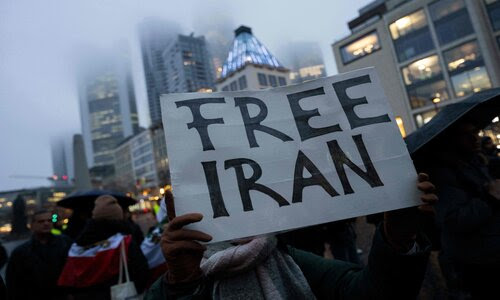
The silence from the chattering classes, Hollywood elites, and university students and faculty has been deafening. The same people who have been conducting mass demonstrations and virtue-signaling about their devotion to the cause of human rights and their abhorrence of civilian casualties when it came to the war in Gaza have been largely silent about what is happening in Iran.
That isn’t because no one knows exactly what’s going on.
Despite attempts by the Islamist regime to black out the internet and halt the flow of information about events inside the country, the scale of the conflict has grown so large that it has been impossible to cover up. Some 2,500 deaths have been confirmed by the U.S.-based Human Rights Activists News Agency, though reports on mass killings of protesters by the Islamic Revolutionary Guard Corps have raised the potential death toll to anywhere from 12,000 to 20,000.
While the liberal mainstream media was slow to pick up the story, it can no longer downplay it. While it has had to compete with its overwraught coverage of the controversy about the Trump administration’s efforts to enforce immigration laws, the Iran protests have been the top story on The New York Times website for multiple days, and have also received extensive coverage in The Washington Post and on NPR. Even leftist human-rights groups like Amnesty International and Human Rights Watch have been posting about it.
Apathy about Iranian victims
But the statistics about casualties and images of military forces shooting peaceful protesters in cold blood haven’t moved the audiences of these outlets in the way they normally do about another conflict in the Middle East. In fact, the same audience that turned out in the tens of thousands to protest the war in the Gaza Strip or to broadcast their identification with Palestinians has zero interest in the Iranian struggle for freedom or the many victims of the Islamist regime.
This apathy makes itself felt on a number of different levels.
No mass street protests, demonstrations or tent encampments can be found in U.S. cities or on college campuses dedicated to supporting Iranian protesters. The opinion columnists at major outlets who have been churning out articles falsely accusing Israel of “genocide” while parroting grossly inaccurate Palestinian casualty figures are mum about Iran. At the Golden Globes awards ceremony, actors and others in past years have shown off their support for the Palestinian war against Israel via lapel pins or biting words. At the event held this past weekend, the cause de jour was protests against the U.S. Immigration and Customs Enforcement Agency (ICE). Not a single person–either on stage or in the audience, as can be seen from the media coverage–was standing in solidarity with the people of Iran.
That’s not surprising.
Concern about the way the Islamist theocracy oppresses the people of Iran has never been among its priorities. Or even a subject about which they were even minimally concerned.
The question is why–given everything heard from the crowd about how terrible it is for the innocent to be killed in conflict–they have nothing to say about Tehran? They’re all very vocal about the backing of a “Free Palestine.” Not so much about a free Iran.
It’s true that not as much attention has been paid to the conflict in Iran as there has been for the two-year war in Gaza; however, a good number of Iranians have been fighting against the mullahs since the Islamic Revolution in 1979.
Another reason may be that the State of Israel is supported by the United States. It’s true that even when Washington was most sympathetic to Iran, and seeking to appease its government during the Barack Obama administration, and to a lesser extent, when Joe Biden was president, America didn’t formally support the government of Iran.
If anything, the fight for freedom there ought to be generating a lot more foreign support than the Palestinian cause. After all, the Palestinians have rejected compromise, peace and a two-state solution to end the Arab-Israeli conflict for nearly a century. And the recent war in Gaza wasn’t an Israeli attempt to stifle democratic protests. It was a morally justified response to a cross-border invasion by Palestinian Arabs on Oct. 7, 2023, which resulted in an orgy of mass murder, rape, torture, kidnapping and wanton destruction.
The main impetus for those rallies, however, wasn’t focused on ending ties between Washington and Jerusalem, though most of the protesters were surely in favor of that idea. Nor was the motivation for the protests simply a matter of backing a ceasefire in the fighting that followed the Oct. 7 massacre in Jewish communities in southern Israel. The ceasefire reached last October didn’t really dampen the ardor of the anti-Israel crowd. It was also not a matter of genuine sympathy for victims; if that were the case, they wouldn’t have been indifferent to the plight of Israeli hostages and would still be out advocating for the reconstruction of the Gaza Strip.
Rather, as the chants of the pro-Hamas mobs made clear, it was their support for the desire of the Palestinians to see Israel eradicated (“From the river to the sea”) and for violence against Jews wherever they lived (“Globalize the intifada”) that lured them to join the cause.
Despite their loud proclamations that the anti-Israel protests were rooted in concern about human rights–something that would surely cause them to speak out about Iran–that just doesn’t pass muster. Nobody who actually cares about human rights can support a cause that aims at the slaughter of an entire people, no matter where they live.
Racialist myths
The reason for this can partly be explained by simple ideology. The indoctrination of a generation in the toxic ideas of critical race theory, intersectionality and settler-colonialism has led many young people to believe that all conflicts are essentially about race.
As such, they have come to believe that the world is divided into two groups perpetually at war with each other: oppressed “people of color” and their “white” oppressors. In that essentially Marxist formulation, Jews are, despite their history of persecution and the persistence of antisemitism, too Western and too successful to merit sympathy, and so must be defined as “white” oppressors. That makes the Palestinians the oppressed racial minority. They believe this myth, even though Jews and Arabs are the same race, and the majority of Israelis are people of color since they trace their origins to the Middle East and North Africa.
The struggle of Iranians to end the rule of tyrannical Islamist theocrats and their terrorist henchmen is irrelevant to this framework because neither side can be identified as “white.” That makes it irrelevant at best, and at worst, a distraction from more interesting battles like the one against Israeli Jews.
It’s equally true that those influenced by these ideas also can’t identify with any struggle against a government that regards itself in conflict with the West, which the intersectional left considers to be irredeemably racist. As historian Niall Ferguson sagely pointed out in The Free Press, because the Iranian protests are an attempt at a “counterrevolution,” rather than one against a pro-Western government, they are indifferent to it. In this way, the reactionary Iranian regime–which, like Hamas, oppresses women and considers gays to be worthy of the death penalty–gets a free pass.
That’s as illogical as it is absurd since it leads people who would be hanged or thrown off rooftops in Gaza or Tehran to march with “Gays for Palestine” placards. Yet it does make sense to those who consider the West, the United States and Israel to be inherently evil, and their opponents, even when they are Islamist murderers, to be somehow sympathetic.
It’s the same reason why far larger and bloodier conflicts, such as the decade-long Syrian civil war–when hundreds of thousands died, and millions were made homeless–never motivated anyone on the left to take to the streets demanding action to stop the fighting. The same was true for what is a real genocide going on in Sudan right now.
The left and right unite in their antisemitism
Still, there’s more to it than just that stale and intellectually vapid ideological construct. The “horseshoe” effect, in which the far left and the far right unite in their antisemitism, is at play when it comes to Iran as much as it is about Gaza.
Anti-Israel extremists on both the left and right are speaking out against any help for the protest movement in Iran. The likes of journalists Max Blumenthal, Glenn Greenwald and Ali Abunimah say they oppose the protests because the demonstrators’ foreign sympathizers just want a pro-Israel government in Tehran. That misses the point. Of course, many people in the West would prefer a government that wasn’t the world’s leading state sponsor of terrorism. But apologists ignore the fact that one of the reasons why Iranians want to overthrow their Islamist tyrants is because the regime has squandered its country’s resources in its frenzy to build a nuclear bomb to obliterate the Jewish state. And that’s despite the fact that Israel and Iran have no real reason to be in conflict other than because of the mullahs’ antisemitic obsessions.
As seen in recent months, the obsessive hatred for Israel on the part of a certain segment of right-wing opinion also leads those who take this position to be supportive of anyone who claims to be an anti-Zionist, even if that leads them to back some of the most anti-American regimes and people in the world.
It’s no accident that former Fox News host and current podcaster Tucker Carlson has been adamant about opposing American efforts to stop Iran from getting a nuclear weapon or efforts on the part of the Trump administration to support anti-regime protesters. The same is true of former Trump staffer turned extremist podcaster Steve Bannon and neo-Nazi “groyper” leader Nick Fuentes.
Though these people claim to be American patriots and believers in an “America First” or “America Only” foreign policy, they oppose efforts by the Trump administration to rein in and stop a regime that has killed Americans and views the United States as the “great Satan,” regardless of its position on Israel.
The only thing that brings them into agreement with the left on Iran is the fact that the Tehran theocrats hate Israel.
There’s no way to look at this issue that doesn’t inevitably lead back to an age-old hatred.
As with other global struggles, antisemites on both ends of the political spectrum are never going to care about a conflict in which neither side is Jewish. As for Iran, its radical oppressors not only support efforts at Jewish genocide but spend enormous sums on terrorist groups and a nuclear program with which that evil objective could be accomplished–money its population never sees.
Under those circumstances, it is to be expected that the same crowd who write, rally and virtue-signal their anguish about Palestinians will be utterly indifferent to the plight of Iranian victims at the hands of Islamists. The explanation isn’t merely ideology or hypocrisy. It can be summed up on one basis: Jew-hatred.
Viral Comedy Video On Mega Church Culture Is Wake Up Call
Sometimes the most uncomfortable truths don’t come from theologians, pastors, or church councils—but from comedians. In a cultural moment when trust in institutions is already fragile, a viral comedy sketch mocking megachurch culture has pierced the Christian conscience in a way sermons often fail to do. Not because it was kind. Not because it was reverent. But because it rang painfully familiar.
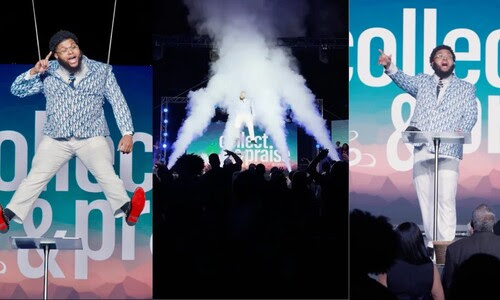
Comedian Druski’s two-and-a-half-minute parody of megachurch theatrics has exploded across social media, racking up tens of millions of views and igniting fierce debate within Christian circles. In the video, Druski caricatures a prosperity-flavored pastor complete with staged healings, smoke machines, designer clothes, wire-assisted “anointing,” and relentless fundraising appeals—all set to the soundtrack of hype and spectacle. The satire was sharp, exaggerated, and undeniably funny. But it was also unsettling, because so much of it felt recognizably real.
Suspended above the pulpit in Christian Dior and red-bottom Christian Louboutins, Druski’s faux pastor proclaims himself holy while demanding millions from a cheering congregation. At one point, he declares no one can leave until $4 million is raised for a vague overseas mission project. The joke landed not because it was outrageous, but because it mirrored stories people have heard—and experiences some have lived.
Predictably, backlash followed. Some Christians accused Druski of mocking the Church itself. Others saw the sketch as a cheap shot at sincere believers. But perhaps the most telling response came not from offended church leaders, but from Christian hip-hop artist Lecrae, who refused to clutch pearls or play defense.
Lecrae’s reaction was strikingly honest. He didn’t see the sketch as an attack from the outside, but as a mirror held up to uncomfortable realities within the Church. “When a comedian is shining a light on it, he’s not inventing something out of thin air,” Lecrae said. “He’s actually reflecting what people have already seen.” His words carried weight because they acknowledged what many believers whisper privately: there are wolves in pulpits, theatrics fueled by ego, and leaders who manipulate God’s name for personal gain.
That admission matters. For too long, segments of the Church have treated criticism as persecution and accountability as betrayal. The assumption that sacred spaces must be immune from scrutiny has allowed abuses—financial, spiritual, and moral—to fester. Lecrae rightly challenged that instinct. If the Church truly is sacred ground, then it deserves more accountability, not less.
This viral moment is not an argument for abandoning church. Lecrae was clear on that point, offering a simple but powerful analogy: a filthy restaurant doesn’t make you swear off food forever—it makes you avoid that particular place. The issue isn’t Christianity. It’s a version of church culture that has confused production value with spiritual power, applause with anointing, and fundraising prowess with faithfulness.
And this is where the conversation becomes larger than one video or one comedian.
Across denominations, a quiet shift is taking place—especially among younger believers. Trip Lee, pastor and artist, has observed a growing hunger for depth over spectacle, substance over show. For a generation raised on endless content, curated experiences, and relentless marketing, the Church’s attempts to out-entertain the world often feel hollow. Smoke machines and LED walls cannot compete with TikTok, Netflix, or concert-level production. And increasingly, young Christians aren’t asking the Church to try.
What they want is something the world cannot offer: reverence, meaning, truth, and encounter.
Studies showing young people gravitating toward small, historic, and Orthodox churches aren’t accidental. They point to a desire for something sacred—spaces that feel rooted, serious, and spiritually weighty even when there are serious theological questions that need to be addressed about such churches. In a chaotic world, authenticity has become more compelling than novelty. People aren’t impressed by pastors who look like celebrities. They are drawn to shepherds who sound like shepherds.
This doesn’t mean all megachurches are corrupt or shallow. Many faithfully preach the Gospel, serve their communities, and operate with integrity. Lecrae himself was careful to say the stereotype does not apply universally. But stereotypes exist for a reason, and when they persist, they deserve examination.
The deeper warning exposed by Druski’s parody is not about clothing brands or building sizes—it’s about what happens when the Church starts speaking the language of power, wealth, and influence more fluently than the language of repentance, sacrifice, and holiness. When worship becomes a product, pastors become performers, and congregants become consumers, the Gospel inevitably gets distorted.
Ironically, the solution is not innovation, but faithfulness. As Trip Lee noted, the Church doesn’t need new tricks. It needs to do the old things well—preach the Word, administer the sacraments, pursue holiness, love the poor, and call people to repentance and new life in Christ.
The viral sketch wasn’t a declaration of war on Christianity. It was a wake-up call. And the Church would be wise not to shoot the messenger.
If the world is laughing, it may be because it recognizes something the Church has been slow to confront. The question now is whether believers will respond with outrage—or with humility, repentance, and renewal.
Because the hunger is real. The desire for depth is growing. And the Church still has something no comedian, no production, and no viral moment can replace: the life-changing Gospel of Jesus Christ.