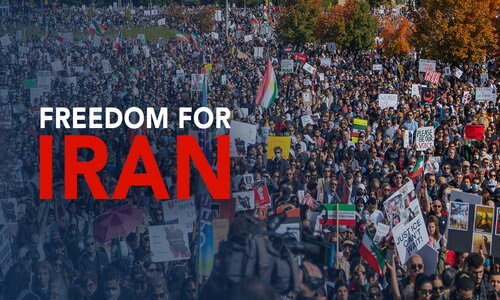
Bible Prophecy, Signs of the Times and Gog and Magog Updates with Articles in the News
Has Time Finally Run Out For Tehran’s (Magog) / (King of the North) ( Persia) Islamist Tyrants?
For the past 16 years, the world has continued to ask the same question with respect to the Islamist regime in Iran: Is it finally time for the despotic rule of the ayatollahs to end? Yet hopes that Iran might finally free itself have continually been disappointed. That’s why even amid the heightened expectations that the breaking point has been reached, optimism about its imminent fall should remain tempered.
The theocracy imposed on the country in 1979–when the government of Shah Reza Pahlavi collapsed and was replaced by the rule of religious extremists, led by the Ayatollah Ruhollah Khomeini–has survived every previous challenge. Despite its manifest unpopularity, it has repeatedly been able to mobilize both the Islamic Revolutionary Guard Corps and the nation’s army to suppress protests with the sort of deadly force that intimidated a restive population into sullen acceptance of their fate.
Nevertheless, the Islamist government’s inability to effectively run a country rich in natural resources but now facing shortages of energy and clean water, as well as having wasted massive sums of money on building a nuclear program at home and funding terrorism abroad, has once again brought it to the brink.
Trump’s threats
Speculation that the time has finally arrived for the fall of Iran’s theocratic government is centered on the latest round of protests spreading throughout the country. An Iranian dissident site, the Human Rights Activists News Agency, reported on Jan. 6 that after 10 days of demonstrations, 34 protesters had been killed and more than 2,000 had been arrested in 285 separate anti-regime rallies.
Unlike in the past, such as in 2009, when massive protests occurred, and in the fall of 2022, when women took to the streets after the death in police custody of 22-year-old Mahsa Amini, the United States isn’t signaling its passive support for the tyrants of Tehran. Under President Barack Obama, who was already planning a campaign of appeasement of the regime that would lead to the disastrous 2015 Iran nuclear deal and failed to speak out in support of the demonstrators, President Donald Trump has left no doubt about where the United States currently stands on the issue of Iran’s future.
He warned that American armed forces are “locked and loaded,” and ready to intervene. “If they start killing people, like they have in the past, I think they’re going to get hit very hard by the United States,” Trump said last week.
Given that the United States took part in a joint air campaign with Israel last June to take out Iran’s nuclear facilities, neither the Iranians nor anyone else should regard that as an idle boast or typical Trumpian braggadocio. Over the weekend, Trump sent in American forces to capture Venezuelan dictator and narco-terrorist Nicolás Maduro and bring him back to the United States to face justice.
That should have further concentrated the minds of Iran’s leaders on the prospect of what happens to deposed tyrants. If they don’t make it to safety in friendly countries, their fate could be even less pleasant than that of Maduro. While none of them are currently under an American indictment, the reports that Iran’s Supreme Leader, Ayatollah Ali Khamenei, has already planned to escape to Moscow with his family and aides should the regime’s forces fail to quell the protests. That’s a sign that they understand that their continued grasp on power is not guaranteed.
The problem, though, is that the ayatollahs and the leaders of the IRGC are acting like they do plan to hold on. And the explanation for their strategy should sober up optimists who, not for the first time, are already making bold predictions about what a new Iran would look like and who might govern it.
Iron rules of history
The Iranian regime is still dangerous for three important reasons that separate it from historical examples of past tyrannical regimes that collapsed, such as that of France’s monarchical ancien regime in 1789 or the Soviet Union in 1991. Unlike those governments, many, if not most, of those who serve Iran’s theocracy are still ardent believers in the Islamist faith that has been its guiding force for the last 46 years.
It’s also true that, unlike the ayatollah, most of them don’t have anywhere that they can flee to while holding on to their assets. As a result, the regime’s henchmen–both in the IRGC and the army–seem willing to obey orders and kill as many of their compatriots as is necessary to once again stamp out hopes for freedom.
It remains an iron rule of history that tyrannies do not end because they are brutal. They collapse when they are no longer able to count on their loyalists to be brutal. They only fall when they are either conquered by external forces (i.e., Nazi Germany or Imperial Japan) and/or experience military defeat that destroys their credibility (i.e., the junta in Argentina after its failed 1982 invasion of the Falkland Islands). Or they go down after suffering a collapse of faith in a regime’s legitimacy and belief system, as in the case with France in 1789, and Moscow’s evil empire after the fall of the Berlin Wall and the dissolution of the Soviet Union.
Is such a crisis of faith happening in Tehran? It’s hard to know for sure.
Their defeat at the hands of Israel and the United States, when their planes had free rein over Iran’s skies as they sought out its nuclear and other targets, might turn out to be a tipping point. That was a body blow to a government that only a few years ago seemed well on its way to achieving regional hegemony with clients in power in Iraq, Syria, Lebanon and part of Yemen. The Israeli rout of Tehran’s Hezbollah auxiliaries in 2024 was an unexpected setback for a terrorist force that for years seemed to be invincible in Southern Lebanon. That, in turn, led to the end of the Bashar Assad regime in Syria in December 2024, a nation that seemed to be in Iran’s pocket up until then.
Add to that the growing economic collapse of the country, and it’s hard to see how a government that still sees itself as an expression of Islamist revolution can cling to power.
Yet while the casualty figures from anti-regime protests and the claims that demonstrators are prevailing in some parts of the country are a potential sign of regime collapse, the fact that army and IRGC forces are still firing on dissidents and killing dozens could indicate that the regime’s taste for blood and their ability to shed it have not slackened.
Moreover, despite the encouragement they’re getting from Washington and Jerusalem, Iran’s protesters should be under no illusion that this time, the Americans or Israelis will do their fighting for them.
Trump’s tough talk notwithstanding, implementing threats in South America, which is in Washington’s backyard, is a far cry from doing so in the Middle East. Trump might order some airstrikes on regime targets, but he’s not going to make the mistake of engaging in an invasion that might lead to American occupation of part of Iran. Trump wants to use U.S. military force to make the Iranians pay a high price for bloody repression and continuing to spread terror. He has no interest in occupying the country or replicating the mistakes made in Iraq and Afghanistan during the long wars there that Americans grew tired of.
The Iranians must do it
If the rule of the ayatollahs is to end, it will require at least some of the Iranians with guns–in either the IRGC or the army–to turn them on their rulers. Americans, and even Israelis, might be prepared to help them become free. However, they are going to have to do most, if not all, of the hard and likely bloody work of overthrowing the theocrats themselves.
As illogical as it may be for an incompetent government that turned a rich land into a failed state to be able to hold onto power, Khamenei and his followers could do so if enough of their minions are still ready to slaughter more innocents demonstrating for freedom.
So, while Americans should be doing everything possible to encourage Iranians to throw off their shackles and rejoin the international community, it’s by no means a certainty that this is going to happen or that even American assistance will make it a realistic possibility.
That’s a discouraging thought for those who recognize just how dangerous Iran has become, both because of its status as a threshold nuclear power (or, at least, it was until last June) and its being the world’s leading state sponsor of terrorism. Still, if Iranian opponents of the theocracy can’t find a way to persuade at least some of the regime’s enforcers to lay down their arms, then all the optimism about the end of the long Islamist nightmare will prove unfounded.
When Christian Leaders Fall – How Should We Respond?

For decades, Philip Yancey was one of the most trusted voices in American Christianity. His books on grace, doubt, suffering, and faith in a broken world sold more than 15 million copies and found their way into churches, small groups, hospitals, prisons, and living rooms across the globe. Yancey had a rare gift: he could speak honestly to believers wrestling with pain without surrendering truth, and he could speak to skeptics without sounding defensive or hollow.
For many, What’s So Amazing About Grace? was not just a book–it was a lifeline.
That is what makes his recent admission so devastating.
In a statement to Christianity Today, Yancey confessed to an eight-year extramarital affair, calling it a “personal devastation” and acknowledging that his actions contradicted everything he taught about marriage, faith, and obedience. He described remorse, repentance, and a dependence on God’s mercy, while announcing his retirement from public ministry to focus on rebuilding his 55-year marriage. His wife Janet, speaking honestly about trauma and devastation, asked for prayer while clinging to grace.
The news landed like a punch to the gut–not only because of who Yancey is, but because of what he represented.
So now the hard questions begin.
What do we do when Christian leaders fall?
Do we discredit everything they wrote?
Do we excuse the sin because of their influence?
Do we rush to forgiveness without truth–or to judgment without grace?
And perhaps most uncomfortable of all: What does this reveal about us?
The Danger of Thinking “It Could Never Be Me”
One of the clearest lessons in moments like this is also the one we resist most: no one is immune to sin.
Scripture does not hide this truth. David was a man after God’s own heart–and an adulterer. Peter preached boldly–and denied Christ three times. Paul called himself the chief of sinners even after decades of ministry. The Bible’s honesty about human frailty is not accidental; it is a warning.
The danger is not merely sin–it is confidence. The quiet belief that longevity, knowledge, success, or public respect somehow insulates us from temptation. When Christians begin to believe their theology protects them more than vigilance, they are already drifting.
Yancey’s confession should not lead us to smug distance–“How could he?”–but to sober reflection: Where am I unguarded? Where have I mistaken reputation for righteousness?
Temptation rarely arrives loudly. It creeps in through isolation, secrecy, fatigue, unchallenged patterns, and the belief that consequences will never reach us.
Does Failure Erase Truth?
Another painful question follows quickly: Does Yancey’s sin invalidate his work?
Critics–especially non-believers–will call Christians hypocrites, pointing to moments like this as evidence that faith is fraudulent. But that misunderstands both sin and truth.
Truth does not become false because the messenger fails to live it perfectly. If that were the standard, Christianity would have no teachers left–and no Scriptures worth reading. The power of Yancey’s writing was never that he embodied grace flawlessly, but that grace itself is real, necessary, and undeserved.
In fact, his fall tragically underscores the very message he spent a lifetime explaining: we need grace because we fail–even after years of faith.
That does not excuse sin. Grace is not permission. Repentance is not public relations. Trust, especially in leadership, must be rebuilt slowly and carefully, and sometimes not restored at all. Stepping away from ministry is not punishment–it is wisdom.
But we must be careful not to confuse moral failure with doctrinal falsehood. The gospel is not weakened because its messengers are broken; it exists because they are.
What Repentance Actually Requires
Still, grace does not mean the absence of consequences. The Christian response is not blind defense nor public stoning–it is truth, accountability, and humility.
Real repentance is costly. It means exposure instead of secrecy. It means relinquishing platforms, not protecting them. It means rebuilding trust privately rather than performing remorse publicly. Yancey’s decision to retire from public ministry, rather than demand instant restoration, matters.
And it raises a necessary question for the wider church: Do we create environments where repentance is possible–or only where image is protected?
Too often, Christian culture rewards productivity over holiness and influence over integrity. Leaders are applauded for output, not guarded for health. That is a systemic problem, not just an individual one.
What We Can Learn–If We’re Willing
This moment forces the church to slow down and reflect.
We must learn to:
Take temptation seriously, regardless of age or status
Build real accountability, not performative transparency
Separate the truth of the gospel from the failures of its messengers
Respond to sin with both clarity and compassion
Resist the urge to defend “our side” instead of honoring God
And perhaps most importantly, we must remember that Christianity does not claim Christians are better people–it claims they are forgiven ones in need of daily grace.
Non-believers may call this hypocrisy. Scripture calls it reality.
The tragedy of Philip Yancey’s fall is real. The pain to his family is real. The damage to trust is real. But so is repentance. So is mercy. And so is the warning to every believer who thinks they stand too firmly to fall.
If we listen carefully, this moment can still teach us something holy–about humility, vigilance, and the grace that meets us not when we succeed, but when we finally tell the truth.
Iran (Magog) , Israel ( The Women with the 12 stars around her Head) And The United States (The Eagle Wings) All Say That They Are Ready For War.
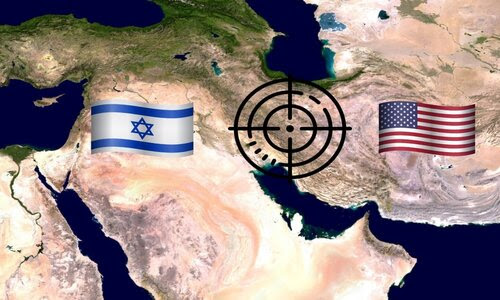
Things are getting very tense in the Middle East. The Islamic radicals that are ruling Iran believe that the United States and Israel intend to use the mass protests that have been going on for nearly two weeks to try to overthrow their regime. If Ayatollah Khamenei and his top advisers reach a point where they are convinced that the Iranian government could actually fall, there is no telling what they might decide to do.
Meanwhile, President Trump has declared that the U.S. is ready to take military action if the Iranians continue to kill more protesters, and Israeli Prime Minister Benjamin Netanyahu has warned that there will be “very severe” consequences for Iran if Israel is attacked. If either Khamenei, Trump or Netanyahu pulls the trigger, the Middle East will erupt in flames.
The mass protests in Iran keep growing, and on Wednesday there were reports of “security forces retreating in the face of fearless, unarmed crowds” in some cities…
On Wednesday, January 7, 2026, the nationwide uprising in Iran entered its eleventh consecutive day, marking a significant escalation in the struggle against the ruling dictatorship. As the sun set on Wednesday, the regime’s suppression apparatus appeared overstretched, with reports emerging from multiple provinces of security forces retreating in the face of fearless, unarmed crowds.
You would think that the security forces should have the upper hand since they are armed.
But when security forces are vastly outnumbered by enormous throngs of protesters, the crowds could rush the security forces and pummel them to death.
So in several western Iranian cities, security forces have been forced to pull back…
While the strikes squeezed the regime economically, the streets witnessed a shifting balance of power. In several cities, the sheer density of the crowds forced heavily armed security forces to abandon their positions.
In Abadan, southwest Iran, security units fled their posts after failing to disperse demonstrators with tear gas. In Bojnurd, the crowds were reportedly so massive that security agents retreated to rooftops to avoid being overrun. A similar scene unfolded in Borujerd, western Iran, where youths armed only with stones clashed with Revolutionary Guard (IRGC) forces, compelling the agents to retreat into their bases.
Of course there have been other instances where Iranian security forces have opened fire with live ammunition.
But even though there have been fatalities, the protesters are not backing down…
However, the regime’s response in other areas was lethal. In Lordegan, within the Chaharmahal and Bakhtiari province, security forces opened fire with live ammunition. Despite the use of deadly force, the residents did not disperse. The fierce clashes resulted in casualties on both sides; reports indicate that four regime agents were killed during the confrontation. The IRGC-affiliated Fars News Agency confirmed the intensity of the fighting, admitting that two police officers were killed, 30 were injured, and both the governor’s office and several administrative buildings sustained damage.
In Shiraz, the urban landscape was transformed into a zone of resistance. As authorities deployed water cannons to clear the streets, protesters countered by constructing barricades. Footage from the city showed a truck dumping a load of stones onto the street to assist youths in reinforcing their defensive lines against plainclothes agents and suppressive units.
The death toll is rising with each passing day.
According to CBS News, at least 36 people have died so far…
At least 36 people have been killed amid major anti-government demonstrations across Iran, a U.S.-based rights group says. The Iranian government is trying to quell the unrest, and reacted angrily to President Trump’s veiled threat of a U.S. armed intervention.
The Human Rights Activists News Agency, which gave the death toll based on its network of contacts in the country, said in its daily report on Tuesday that at least 36 people “have been confirmed killed during the past ten days of protests. Among them were four individuals under the age of 18, as well as two members of security and law enforcement forces.”
Personally, I believe that the true death toll is far higher.
But in any event, everyone agrees that protesters are dying.
On Sunday, President Trump once again warned that the U.S. is ready to hit Iran “very hard” if they keep killing protesters…
“We’re watching it very closely. If they start killing people like they have in the past, I think they’re going to get hit very hard by the United States,” Trump told reporters on Sunday.
By now, it has become clear that Trump is not bluffing when he says stuff like this.
And many members of Congress are cheering him on.
For example, U.S. Senator Lindsey Graham just told Fox News that Trump will kill Ayatollah Khamenei if protesters continue to die…
US Senator Lindsey Graham warned that if Iran’s security forces continue killing protesters, President Donald Trump would order the killing of Supreme Leader Ayatollah Ali Khamenei on Tuesday.
Graham delivered the warning in a Fox News interview, addressing Iran’s clerical leadership and urging an end to the crackdown. His comments came as nationwide demonstrations entered their eleventh day.
Graham said Tehran’s leadership should “take Trump seriously,” asserting that continued lethal force against demonstrators would invite direct retaliation at the highest levels.
I don’t doubt it.
If the Iranians keep firing live ammunition at protesters, I do think that Trump will try to take Khamenei out.
And once Trump decides to move, it can happen very suddenly.
At this hour, Iranian forces are on the highest level of alert…
Iran’s armed forces have been placed at the highest level of readiness, with hundreds of Islamic Revolutionary Guard Corps (IRGC) and regular army units on full alert in response to perceived threats from the United States and Israel, state media reported.
The Iranians clearly remember what happened last year, and they do not intend to be caught by surprise again.
On Wednesday, the head of Iran’s military issued a threat that was quite ominous…
Iran’s military chief warned Wednesday that Iran will not stand by and allow itself to be threatened by outside powers, after the United States and Israel backed anti-government protests.
“The Islamic Republic of Iran considers the escalation of hostile rhetoric against the Iranian nation a threat and will not tolerate its continuation without responding,” General Amir Hatami said, according to the Fars news agency.
Exactly what did he mean by that?
Was he suggesting that Iran could conduct a preemptive attack simply based on “hostile rhetoric”?
The day before, Iran’s Defense Council also brought up the possibility of preemptive action…
Iran’s newly formed Defense Council warned on Tuesday that the country could respond before an attack if it detected clear signs of a threat, a stance that implicitly raised the possibility of preemptive action amid rising tensions with the United States and Israel.
In a statement carried by state media, the council said allegations and interventionist remarks directed at Iran could be treated as hostile acts if they went beyond rhetoric.
It said Iran’s security, independence and territorial integrity constituted a red line that cannot be crossed, and warned that continued hostile behavior would prompt a response, with full responsibility for the consequences resting with those behind it.
If Iran were to engage in some sort of a preemptive strike, Israel would likely be targeted.
The Israelis clearly realize this, and Benjamin Netanyahu has warned that in such a scenario “the consequences for Iran will be very severe”…
Referring to recent Iranian military exercises, Netanyahu added: “I made it clear that if we are attacked, the consequences for Iran will be very severe.”
It certainly feels like something is coming.
Have the Iranians given the Russians advance warning? If Iran feels an attack is inevitable they might strike first before their air defenses and missiles are taken out. It is being reported that the Russians are “urgently” evacuating their diplomatic personnel from Israel right now…
Russia is urgently evacuating diplomatic personnel and their families from Israel, having organized three flights in the last 24 hours. The evacuation is taking place at an accelerated pace, indicating the presence of “important information.”
An evacuation of this nature certainly suggests something is up and at the very least Russia feels precautions have reached the danger zone where their personnel are at risk.
If other nations start evacuating their embassies in Israel and Iran, that will be a major red flag.
Once Israel and Iran start going at it again, it will be a battle for all the marbles.
So let’s hope that cooler heads prevail.
Unfortunately, I don’t think that is going to happen.
I think that events are moving us in a very particular direction, and the whole world is going to be shocked by what is coming next.
A Warning For Parents – How To Lose Your Child To Gender Activists

A gut-wrenching, anonymous column published in the Telegraph on December 15 highlights a uniquely post-modern parental nightmare: “My son took gender-changing hormones behind my back, with the support of his boarding school.”
The anonymous father first discovered that his 14-year-old, referred to by the pseudonym Jonathan, was “struggling” with his gender identity. As is so often the case, the boy spent “hours on end” on his phone in his bedroom, “which is a huge, huge regret now.” Like so many other parents, they had no idea what Jonathan was doing.
Jonathan was talking to strangers online – strangers “who were encouraging him to transition” and “first told him that he might be suffering from gender dysphoria.” Teen friends of his older sister, some who identified as trans, followed suit, as the father discovered when he reviewed his son’s WhatsApp messages and discovered advice such as: “You need to get drugs before your hips fuse.”
Jonathan’s mother had permitted him to use an androgynous name at school, “believing in good faith that if we didn’t come across as in any way ‘transphobic,’ he would listen to us when it came to more serious issues of gender identity, like drugs or surgery.” It appeared to work. He listened. They told him he should wait until he was older before making a decision about taking trans drugs, and they locked down his smartphone.
But as is so often the case – the Substack newsletter “Parents With Inconvenient Truths About Trans” has scores of such stories – they did not count on their influence being subverted by the very adults they had entrusted their son to:
What I didn’t realise was that his school would completely betray us. He was attending a prestigious boarding school in the Home Counties and, even though he was on a scholarship, it was costing us over £20,000 a year. We thought he would be given the best education possible and, more importantly, we thought he was safe. How wrong we were.
When Jonathan returned to school after lockdown, aged 15, he told the school GP that if he didn’t get cross-sex hormones – drugs that would “feminise his appearance” – he would kill himself. She immediately checked him into the local hospital and his mother and I went up to collect him. It was terrifying.
While his parents attempted to help him, the school was working behind their backs, “aggressively affirming him as female, providing him with a girls’ uniform and even putting him on the girls’ sports team.” At the same time, the school agreed that they would not assist Jonathan in getting trans drugs. Jonathan used a school computer and emailed a website to request the drugs. “One of the first questions they asked him was whether he wanted breasts.” He said he did.
“I firmly believe that what drives a lot of these teenage boys is sexual urges,” the father wrote. “And they’re being groomed by older men online … The clinic told Jonathan that he needed to have counselling first (we later learnt it was a one-hour session) before they would send him a box full of cross-sex hormones and blockers. Unbelievably, it was paid for by the clinic itself with something they call a ‘scholarship fund.’ He had pleaded poverty, so they sent him the drugs for free.”
It was a neighbor who alerted him to the fact that Jonathan was taking cross-sex hormones; she noticed because she recognized the effects from other trans-identifying friends. He searched his son’s gaming computer, and discovered that Jonathan had been taking the drugs for more than a year, with the full knowledge of the school:
We confronted the school straight away, demanding to know what was going on. To our surprise, they admitted they knew. The housemaster said that keeping it a secret from us had been the hardest decision of his career, but that he’d sought legal advice. He had been told it was the right decision as it was Jonathan’s private health matter. We were extremely angry, especially as we had written confirmation from them saying they wouldn’t help him.
Their son, now 18, failed at school, pulled £4,000 out of his child trust fund, and “flew to America to be with one of the men he had met online who had convinced him he should be a woman.” He then cut off all contact with his family.
The father misses his son terribly. “My wife likens it to war,” he wrote. “She says that previous generations sent their sons off to battle and you never knew whether they were going to come back in one piece. It feels like that. As for the drug-pushing websites, I believe we are in the presence of evil.”
“They’re damaging children and ruining lives. The people behind them belong in jail.”
The culture wars, in short, are real wars, with real victims. Most often, the victims are the young and impressionable. It is a children’s crusade. The story of this heartbroken father, robbed of his son by the LGBT cult, reminded me of the 2023 documentary Dead Name, in which despairing parents described how they had lost their children to gender ideology. Most simply wanted to talk to their children; to discuss the irreversible implications of these treatments.
Many thought educators and therapists would be their allies. But institution after institution turned against them. They were told they were abusive; that they were contributing to the demise of their children, even as their children – one featured in Dead Name was only four years old – announced that they wanted to begin carving up their bodies and changing their very physiology. The sense of betrayal – of being gaslit – that these parents experience is acute.
Now, this anonymous father is among their ranks.
As Iran (Magog) burns, Ayatollah eyes Moscow (Gog) exit while Trump and Netanyahu plan strike
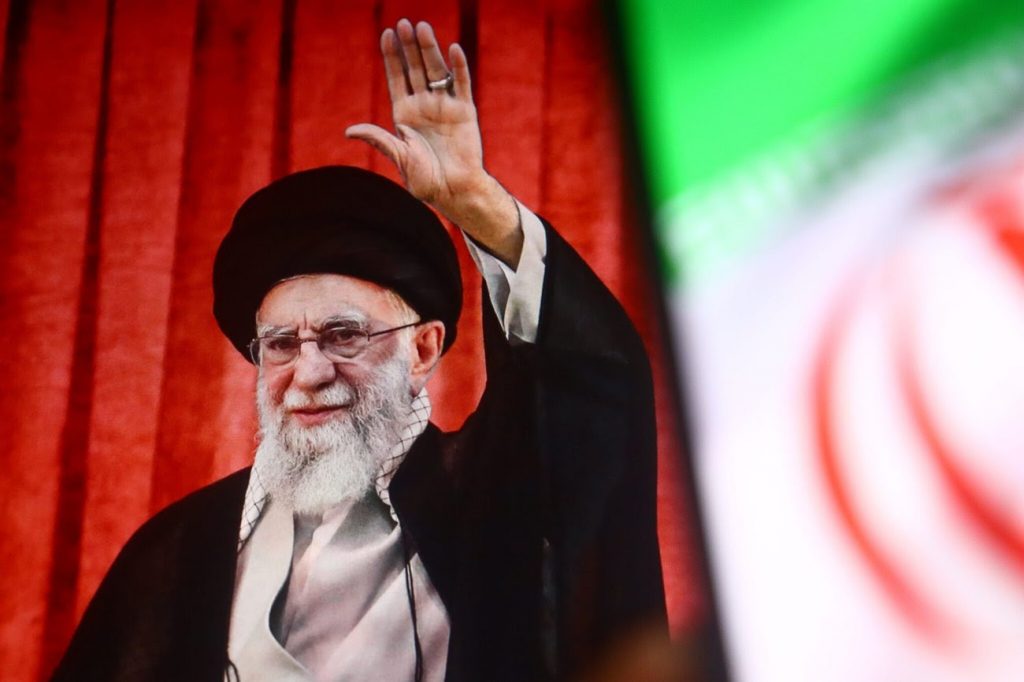
While demonstrators fill the streets demanding freedom, intelligence reports reveal that Supreme Leader Ayatollah Ali Khamenei has prepared an escape plan to Russia, complete with a handpicked entourage of family and aides.