GOG AND MAGOG UPDATE
Magog / Iran introduces stealthy high-speed kamikaze drones
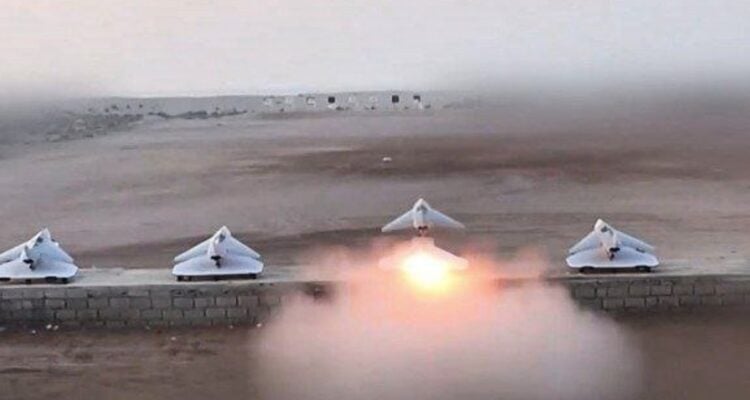
Iran’s Islamic Revolutionary Guard Corps (IRGC) says it has introduced the Hadid-110—also referred to in Iranian reporting as “Dalahu”—a jet-powered “suicide” drone built to arrive faster and be harder to spot than the propeller-driven loitering munitions Tehran and its proxies have leaned on for years.
Iranian-linked reporting frames it as a stealth-oriented platform designed to shrink radar detection range and slash defenders’ reaction time.
The key shift here is speed. The Hadid-110 can reach roughly 517 km/h, and defense analysis sites peg it in the 510–517 km/h band—far faster than the Shahed-136’s typical cruise speed—meaning less warning, fewer engagement opportunities, and a tighter timeline for decision-making.
That matters because many drone-defense systems are optimized around slower, noisier threats.
A quicker, lower-observable airframe forces defenders to detect earlier, track cleaner, and intercept faster—especially if the attacker is trying to slip through gaps in radar coverage.
Iranian reporting also highlights launch flexibility. The Tehran Times describes a rocket-assisted launch concept that reduces reliance on fixed runways or conspicuous launch infrastructure, improving the IRGC’s ability to fire from dispersed positions.
Separately, Al-Monitor reported earlier that Iran unveiled a Hadid-110 variant described as being launchable from underwater—another signal of how Tehran is experimenting with surprise launch profiles to complicate early warning.
Zoom out and the storyline is familiar: Iran doesn’t just build weapons, it builds ecosystems.
The U.S. National Counterterrorism Center describes the IRGC-Qods Force as a central engine for Tehran’s external operations and support to partners and proxies, including providing weapons and training.
Drone tech is a core part of that playbook, and it’s already been exported or replicated in multiple theaters. Iran’s drone transfers and the Shahed-136’s role in long-range “kamikaze” strike campaigns, including in Russia’s war on Ukraine.
For Israel and the region, the significance isn’t that a single new drone “changes everything.”
It’s that Hadid-110 appears designed for a specific mission set: compressing reaction time and probing the seams of layered air defenses—especially if paired with other threats (slower drones as decoys, rockets, cruise missiles) in coordinated salvos.
Iranian media explicitly describes it as suited to hitting sensitive targets like radars, command nodes, and infrastructure—classic “open a corridor” logic.
Much of what’s being circulated about performance and payload comes from Iranian claims and secondary defense analysis, not independent verification.
Still, even the direction of travel is the headline—Tehran is iterating from mass, slow, attritable drones toward faster systems meant to shorten the defender’s clock.
ISRAEL WILL BE READY 30 DECEMBER 2025 : OR WILL THEY ?